
You’ve done the work. You’ve got the results. Now you just need to convince a panel of judges it deserves an award.
The Content Summit Awards recognise great work across content marketing, social media and the creator economy, with categories spanning individual campaigns, agencies, in-house teams, practitioners and creators.
While the judging criteria differ depending on the category, there are some common threads running through the scorecards. Judges want to understand what you were trying to achieve, why you took the approach you did, how well you executed it and, crucially, what happened as a result.
We asked some of this year’s judges what they’ll be looking for when entries land in front of them. Here’s what they had to say, along with a few practical ways to give your work the best possible chance of standing out.
Before judges can appreciate the solution, they need to understand the problem.
“I’m looking for entries that answer three questions: Why this audience? Why this idea? Why did it work?” says Ryan France, Head of Brand Strategy at Kantar (pictured in header speaking at Content Summit 2026).
“Why this audience? Demonstrate a genuine understanding of the people you wanted to influence.
“Why this idea? Show why your approach was the right response to that understanding and the context in which you were operating.
“Why did it work? Provide credible evidence that the content (and not something else) created a meaningful outcome.”
That connection between problem, audience and approach is a consistent theme across the awards program. In categories using an Aim, Execution and Outcome scorecard, judges are specifically asked to consider the objective, the audience insight or need behind it and why the chosen content strategy made sense.
As Erin Core, Managing Director at Veracity Research, puts it: “The strongest entries will show a clear line between the business problem, the idea and the outcome.”
Fractional CMO Zhoe Low (ex-July) brings it back to the fundamentals. “Nail the right concept for the target consumer,” she says, “and present it in a way that gets cut-through.”
So don’t make judges reverse-engineer your strategy from the final work. Tell them what needed to change, who you needed to reach and what you understood about that audience that led you to your idea.
The judges are looking for work with a clear identity.
“First and foremost the brand needs to shine through,” says Kurt Sanders, Head of Brand and Growth at Envigor. “Whether that’s through tone of voice, visuals, or brand assets and codes, it needs to be unmistakably you taking a stand for the thing you’re communicating.”
Alice Harris, Marketing Lead at On the House, has a simple test for that distinctiveness: “If you take away the logo and username, would you still know who the brand is and what they offer?”
Maddie King, Product Marketing Manager at Canva, will also be looking for work that is “genuinely differentiated”. Is there a novel concept behind it, she asks, or is it “just a stale riff off a trend or an existing idea”?
On the creator side, that distinctiveness comes through in voice and personality.
“In an ever-growing avalanche of slop, I’m looking forward to seeing creators’ unique personalities and creativity come through in their content,” says comedian and content creator Zach Mander.
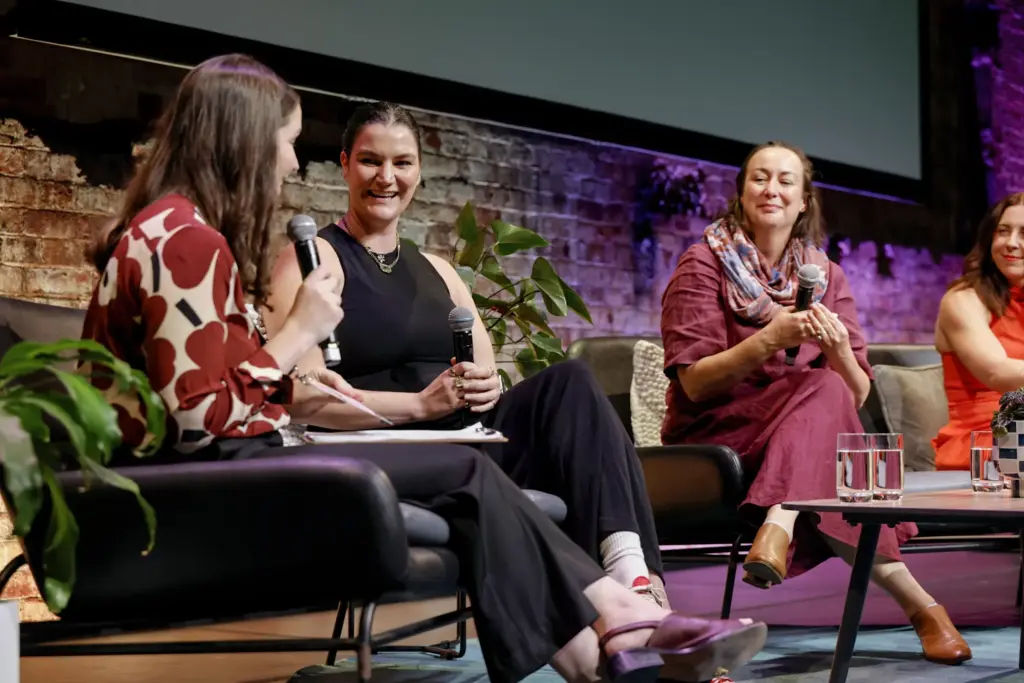
Rachael Sarra (pictured above speaking at Content Summit 2026), multidisciplinary artist, radio host and influencer, will be looking at how a creator’s voice connects authentically with their audience while still aligning with their broader creative direction.
“A strong, defined and authentic voice is key to navigating this space and maintaining a sustainable creative brand in a world that becomes saturated easily,” she says.
Mitch Dale, comedian and content creator, agrees that authenticity plays a key role. “A strong entry for me is high-quality content that feels true to the creator,” he says.
“Many creators know their audience, but are they passionate about and proud of what they’re creating? I want to feel that passion come through the screen. Authenticity can’t be beaten.”
Before submitting, look at the work you’ve chosen and ask what makes it specifically yours. A strong result is valuable. A strong result attached to an idea, voice or creative approach nobody else could have produced is even more compelling.
Originality is valuable, but novelty for novelty’s sake isn’t the goal.
A strong entry should show that the creative idea grew from an understanding of the audience, the behaviour you wanted to influence and the context in which the work appeared.
Jason Kibsgaard, Executive General Manager, Marketing & Proposition at NTI, is looking for “originality, ideas and concepts that understand the audience and put the idea at the heart of that”.
Julia Wyatt is looking for work that “feels considered and brave”.
“I’m looking for entries that challenge the status quo, carve out their own whitespace and show a real understanding of the audience, where they’re showing up and the behaviour they’re trying to tap into, rather than copy-and-pasting the same asset everywhere and hoping it sticks.”
That means explaining more than what you made. Think about the format, platform, tone and distribution choices behind the work. Why a video rather than an article? Why TikTok instead of LinkedIn? Why did a creator partnership make sense for this audience? Why was this particular treatment likely to get someone to stop, watch, learn, click or act?
The scorecards repeatedly ask judges to consider whether the content and format were appropriate to the audience and channel. Your entry should make the rationale behind those decisions clear.
Strategy and results matter. But judges will still be looking closely at the work itself.
Maddie King says she’ll be considering the “quality and taste” of an entry.
“Is this a genuinely high-quality piece of content that has been produced well, even if it’s organic or lo-fi?” she asks. And she adds another, simpler test: “Is it enjoyable to consume?”
That distinction is worth keeping in mind. Production value and execution quality aren’t the same thing.
A simple social video can demonstrate exceptional judgement, writing, timing and platform fluency. A highly produced campaign can still miss the mark.

Lachlan and Austin Macfarlane (pictured above), the Brisbane-based filmmakers known for their viral VFX work, say they’re looking for “creators with a distinctive voice who understand how to engage their audience, and the craft of creating compelling work for online platforms”.
Choose supporting examples that best demonstrate the craft behind the idea. Where relevant, explain the decisions that aren’t immediately visible to the judge, whether that’s how the work was developed for the platform, how different formats played different roles, or how the execution evolved as you learned what worked.
Here’s where a good entry can become a great one.
Across many Content Summit Awards categories, Outcome or Impact accounts for 40 points out of 100. The point isn’t simply to make great content. It’s to demonstrate that the content did what it was created to do.
Jason Kibsgaard wants to see “ideas that have driven effectiveness”.
“Great ideas can’t just be great creatively,” he says. “Have they driven real results, affected an outcome or created a meaningful difference that can be measured?”
Erin Core takes a similar view.
“Whether the goal is behaviour change or commercial growth, great content should create a real-world result,” she says. “The best entries won’t just show what was made, they’ll show the difference it made.”
Danielle Zikman, Director LTS Marketing JAPAC at LinkedIn, will also be looking for “influence that goes beyond the campaign to create measurable impact”, while Michael Apte, General Manager, Strategy at Guide Dogs NSW, says evidence of real-world impact will be one of the things he looks for in an entry.
But “results” don’t have to mean the same thing in every category.
If you’re entering Best Commerce Content, then sales, leads, conversions, click-throughs or revenue attribution may be relevant.
If the goal was behaviour change, the evidence might be sign-ups, donations, policy responses, attitudinal research or another measurable shift in behaviour.
Educational content might be better demonstrated through audience feedback, time spent with the content or evidence that knowledge and capability improved.
Start with the objective, then choose the evidence that actually tells judges whether you achieved it.
And where possible, help establish that the content itself contributed to the result rather than simply putting a large number on the page.
As Ryan France says: “Don’t just show me what you did. Show me why it was the right thing to do, and how you know!”
A metric rarely tells the full story on its own.
Was 100,000 views exceptional for this brand, or fairly typical? Did a small team deliver something normally requiring twice the resources? Did engagement increase dramatically against the previous benchmark? Did the work keep delivering consistently over an entire year?
Rebecca Barnes, Chief Marketing Officer at The Cheesecake Shop, encourages entrants to give judges that context.
“The best entries tell a clear, specific story rather than a vague one,” she says. “Back up impact with real numbers, and don’t undersell a small team achieving a lot with limited resources. That context matters.”
She also cautions against relying too heavily on one standout moment, encouraging entrants to highlight consistency over time where that tells a stronger story.
Don’t assume a judge will automatically know whether a result is impressive. Give them the benchmark, baseline or constraint that lets them understand what the number actually means.
When a piece of work involves an agency, client, creator, production team and other partners, it isn’t always obvious who did what.
That’s something Michael Apte says he’ll be paying attention to.
“I’ll be looking for the quality and depth of the insights, evidence of real-world impact and a clear articulation of the role the entrant played in the work,” he says. “The more open they are about the role they played, the more credible their entry is.”
Spell it out. What did you develop? What did you execute? Where did collaborators contribute? If you’re an agency entering work completed alongside a client and several other partners, make your role easy to understand.
You don’t need to claim every part of a successful campaign for an entry to be impressive. You do need to make clear what you’re asking the judges to recognise.
For the agency, in-house team, practitioner and several creator categories, the judging doesn’t end with great work and strong results.
Innovation and Leadership accounts for another 20 points, with judges looking for evidence that entrants have pushed their craft, organisation or industry forward. Depending on the category, that could mean new formats, methodologies, platform approaches, experimentation, capability building, mentoring, thought leadership or influence on the wider industry.
And innovation doesn’t necessarily mean using the newest technology.
Nic Fry, Chief Marketing Officer at Plungie, says she’ll be looking for “the human fingerprint behind the content”.
“Technology can broaden reach, but the expertise, the thing that actually teaches someone something in a way that benefits the brand and the category, has to stay human,” she says. “What changed for the brand or even the industry as a result?”
The common thread is progress with a purpose. Maybe your team introduced a process that changed how the wider organisation approaches content. Maybe you developed a new method for working with creators. Maybe an experiment became a repeatable format, or your approach influenced others in your field.
Show judges what you did differently and what it enabled.
Judges will be looking at plenty of good work.
The strongest entry isn’t necessarily the one with the longest explanation, the biggest budget or the most impressive-looking deck. The judges are looking for clear, concise submissions, and value quality over length.
Your job is to make the story of the work easy to follow.
Ryan France describes the strongest entries as those where “the thinking, execution and outcome all reinforce one another”.
So before you hit submit, ask yourself: Does the entry show a genuine understanding of the audience? Is it clear why the idea was the right response? Have you demonstrated the quality of the execution? And is there credible evidence that it achieved something?
Connect those dots clearly and give the judges what they need to see why your work stands out.
Entries for the 2027 Content Summit Awards close 30 November 2026, with winners set to be announced at Brisbane Powerhouse on 10 March 2027. Explore the categories and start submitting your entry now.